
Introducing Vectra: Unifying Threat Intelligence and Structured Hunting
The Why: Observations From Incident Response in 2025 and 2026
Over the multitude of incident response engagements executed throughout 2025 and into 2026, consistent failure points have emerged across various environments. Security operations, specifically threat intelligence, hunting, and detection engineering, are frequently operating in isolated silos, or the threat hunting function is entirely absent. A primary driver of this failure is the shift in initial access. Adversaries are bypassing traditional technical perimeters because they are simply logging in. Threat actors routinely leverage credential leaks and initial access brokers to buy their way into networks using compromised identities.
While monitoring identity exposure is a mandatory first step, organizations must also actively hunt for post-compromise behavior once an identity is weaponized. However, where internal threat hunting programs do exist, it is incredibly difficult for them to execute properly. Vectra was built to solve these exact issues, providing a centralized platform to address the core gaps we observe in the field:
-
The Identity Vector: Adversaries are bypassing technical controls by utilizing valid accounts. It is increasingly difficult for defenders to separate legitimate user logins from compromised access without a unified view of exposure intelligence integrated directly into their hunting platform.
-
Intelligence and Preparation: The preparation phase is the most critical part of a hunt, but it is notoriously difficult to standardize. Security teams often struggle to integrate disparate intelligence feeds and lack the time to build necessary context before diving into complex data pipelines.
-
Structured Hypotheses: Without a deterministic plan, analysts lack clear direction. It is challenging for teams to maintain focus amidst network noise, which naturally leads to investigating irrelevant anomalies and expending critical time on unproductive paths.
-
Skill Variance: Security teams naturally consist of personnel with varying levels of experience and technical capability. This variance makes it hard to achieve consistent outcomes, as analysts evaluating the exact same telemetry may extract different artifacts and reach different conclusions.
-
Broken Feedback Loops: Even when hunts are conducted, teams face significant hurdles in systematically identifying visibility gaps, repairing broken data pipelines, and documenting findings in a format that directly improves future detection engineering.
The Access Shift: Identities as the New Perimeter
Adversaries are no longer breaking in. They are logging in. To illustrate this operational reality, consider the negotiation transcript below. In this real chat log, an Akira ransomware affiliate explicitly states how they breached the target environment.


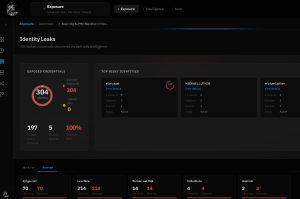
Because threat actors are weaponizing valid accounts, defenders must have visibility into external exposures before those accounts are used internally. Vectra actively monitors dark web marketplaces, credential leaks, and varied threat actor collections for your specific organization.
This intelligence does not sit in a silo. Vectra directly feeds these compromised identity metrics into the active threat hunting function. This allows teams to focus their telemetry queries on post compromise behaviors, lateral movement, and privilege escalation tied directly to those specific exposed identities.
Where Hunt Teams Fail
Even when security operations recognize the need to actively hunt, executing these operations consistently is notoriously difficult. The failure is rarely due to a lack of effort. Instead, teams are constrained by fragmented tools and inherently fragile workflows.
-
Intelligence Integration: Teams struggle to operationalize external data and frequently lack the bandwidth to correlate actor behaviors before querying their environment.
-
Skill Variance and Analyst Bias: Security teams consist of personnel with varying technical capabilities and inherent investigative biases. Without a structured framework, this variance guarantees inconsistent outcomes.
-
The Preparation Bottleneck: Preparation is the most critical phase of a hunt, yet it remains the hardest to execute quickly. Teams expend excessive time manually configuring queries, defining data requirements, and formatting notes rather than aggressively hunting.
-
Siloed Execution: Analysts lack a centralized workspace to collaborate, standardize hypotheses, and save repeatable hunt packages. Without exportable timelines and editable detection profiles, hunts remain isolated events instead of a continuous capability.
-
Broken Feedback Loops: A hunt must improve the overall security posture, regardless of whether a compromise is found. However, teams face significant hurdles in systematically identifying visibility gaps, repairing broken data pipelines, and documenting findings in a format that directly feeds back into detection engineering.
By providing a unified platform equipped with a continuously updated attacker, detection marketplace, and intelligence database, Vectra enables teams to seamlessly generate pre-built hunt packages, align on a shared timeline, and execute hunts better and faster.
Centralized Intelligence: Profiling the Adversary
A structured hunt begins with accurate intelligence. Instead of manually correlating fragmented open-source feeds, analysts use Vectra to establish an immediate, comprehensive profile of the target actor before querying their environment. In this demonstration, we examine the profile of Akira ransomware affiliates.
Vectra aggregates critical operational data into a single, unified interface. This centralization accelerates the preparation phase and ensures the entire team operates from the exact same factual baseline:
-
Tactics, Techniques, and Procedures (TTPs): Maps the exact execution chain, from initial access via unpatched VPN gateways to double-extortion exfiltration.
-
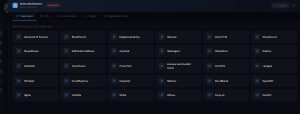
Adversary Tooling: Identifies the specific dual-use and malicious utilities actively deployed by the affiliate, such as Advanced IP Scanner for discovery or AnyDesk for persistence.
-
Indicators of Compromise (IOCs): Provides verified file hashes, naming conventions, and known staging directories.
-
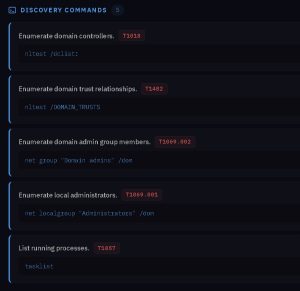
Execution Commands: Details the exact CLI syntax and scripts observed in prior intrusions, such as the specific PowerShell commands utilized to perform discovery.
-
Exploited Vulnerabilities: Highlights the specific CVEs routinely targeted for initial access or privilege escalation.
-
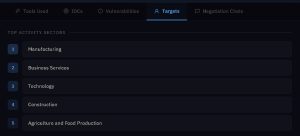
Target Demographics: Outlines historical data on the specific industries and organization sizes the affiliate historically attacks.
-
Negotiation Transcripts: Provides primary-source chat logs detailing the actor’s operational cadence and access methods, sourced directly from dark web collections.
By standardizing these data points upfront, teams eliminate the friction of intelligence gathering. Analysts can transition seamlessly into hypothesis generation with a unified, factual understanding of the threat they are hunting.
Structured Preperation: Aligning to PEAK and ABLE
Threat hunting cannot be an ad hoc process. To eliminate investigative variance, Vectra operationalizes the PEAK (Prepare, Execute, and Act with Knowledge) framework directly into the analyst workflow. This ensures every engagement, whether for an internal network or an external client, follows a deterministic path.
-
The Preparation Phase: Before executing a single query, teams must define the environment. Vectra centralizes engagement scoping. Analysts explicitly outline key contacts, targeted departments, high value assets, network login telemetry, and deployed MDM software. This upfront work prevents teams from hunting blindly and establishes the exact baseline they are defending.
-
Hypothesis Generation (ABLE): A hunt will fail without a targeted hypothesis. Vectra forces analysts to define their parameters using the ABLE framework. Hunters must specify the Actor (the suspected entity), the Behavior (the specific TTP or scenario), the Location (the expected network segments or endpoints), and the Evidence (the exact log sources required for validation).
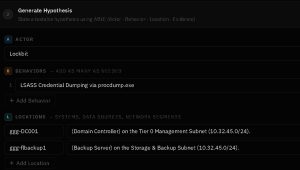
-
Hunt Packages: Once the hypothesis is formalized, it links directly to a prebuilt or custom Hunt Package within the platform. This bridges the gap between the preparation phase and active execution, ensuring the query logic matches the intelligence profile.
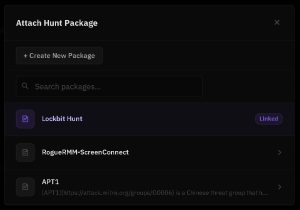
-
Standardized Output: The entire structured profile can be exported instantly to JSON, Markdown,or PDF. This capability standardizes the output for executive reporting and client deliverables.
By enforcing this structure, Vectra guarantees all hunt data remains stored centrally. This enables continuous team collaboration, preserves historical reference for future sweeps, and ensures the findings directly feed back into the security operations loop to improve detection engineering.
The Detections Database
With the hypothesis established, analysts must translate the ABLE framework into executable queries. Vectra centralizes this transition through a comprehensive Detections Database, eliminating the friction of manual query engineering.
Threat hunting often stalls when analysts are forced to switch between platforms and guess syntax. Vectra solves this by providing a centralized repository of detection logic that bridges the execution gap:
-
Platform-Agnostic Translation: The database maps all MITRE ATT&CK TTPs directly to executable syntax across major security platforms, including Splunk, Elastic, and CrowdStrike. This supports various operating systems and completely eliminates query guesswork during an active hunt.
-
Contextual Customization: Threat hunting is not one-size-fits-all. Analysts retain full control to edit and tune the pre-built detection logic directly within the platform. This ensures queries can be instantly adjusted to accommodate specific organizational baselines or unique network configurations.
-
Hunt Package Integration: Detections do not exist in isolation. Hunters can push specific queries directly into an active Hunt Package or build entirely custom packages from the database. This guarantees that the technical execution strictly aligns with the prepared intelligence profile.
-
Identifying Visibility Gaps: By comparing the tested detection logic in Vectra against the actual telemetry returning from the SIEM or EDR, teams immediately identify logging failures. This exposes exactly what the current toolset is missing, providing the precise data needed to repair broken pipelines.
Executing the Hunt: Standardized Hunt Packages
With detections selected and hypotheses set, analysts move directly into execution. Vectra operationalizes this phase through Hunt Packages, allowing teams to run either pre-built templates or custom profiles designed for specific environments.
This phase replaces fragmented notes and ad hoc SIEM queries with a deterministic, repeatable workflow:
-
Guided Execution: The platform keeps the investigation strictly formatted. Analysts simply run the pre-made or dynamically edited queries step-by-step, eliminating the need to continuously rebuild logic during an active operation.
-
Dynamic Workflow: An investigation is rarely static. Hunters retain the flexibility to add or remove steps as the data dictates. Analysts embed their specific notes directly into the active package to capture real-time context without breaking the overall structure.
-
Integrated Timelining and Conclusions: As artifacts are discovered, analysts can push critical findings directly to an attached timeline (detailed in the next section). Once the execution phase wraps, the team documents their final conclusions directly within the package.
-
Automated Reporting: Vectra automatically structures the entire engagement—including queries, notes, and the final verdict—for immediate export. Teams can push this formatted output via Markdown, Microsoft Teams, Slack, or email without spending hours writing manual reports.
-
Historical Repeatability: Every executed hunt is dated and saved natively within the platform. This preserves the historical progression of the environment, allows analysts to easily re-run exact past sweeps, and ensures the data is seamlessly shared across the wider security operations team and executive leadership.
Timelining: The Record of Execution
A threat hunt is only as effective as its timeline. Analysts must view artifacts holistically across disparate security platforms to accurately reconstruct execution chains. Timelining provides the chronological record of what was actually observed in the environment.
Vectra centralizes timeline creation directly within the analyst workflow. This eliminates fragmented spreadsheets and ensures the data remains natively within the platform for continuous team collaboration and historical reference.
-
Customizable Structure: Hunters retain full control over the data format. Analysts can add custom columns and rows to structure the timeline exactly as the specific dataset or engagement requires.
-
Context and Categorization: Analysts inject notes and context directly into the event flow. Crucially, individual artifacts can be explicitly tagged by severity and function—such as Critical, Pivot Point, or Informational—to immediately highlight the most vital indicators to the wider team.
-
Hunt Package Integration: The timeline does not exist in a vacuum. It attaches directly to specific hunt packages and overall engagements. This ensures the chronological evidence is permanently linked to the original hypothesis and the exact queries executed.
This unified approach ensures that every extracted artifact is documented, categorized, and immediately accessible to drive the final conclusions of the hunt.
Conclusion
Threat hunting cannot exist in a vacuum. It must be a structured, repeatable capability that continuously feeds back into detection engineering. Vectra centralizes intelligence, preparation, and execution to eliminate operational silos and ensure every hunt directly hardens the environment against future intrusions.
Can Your Organization Benefit from Vectra?
If your security team needs to standardize its hunting workflow and move from unstructured data to deterministic execution, we can help.
Fill out the form on the following page to learn more, or contact our Senior Sales Manager, Gabriel, directly to schedule a technical demo or bypass the demo and begin onboarding.
- Contact Gabriel to get started: [email protected]
- Fill out our form to learn more: Vectra Threat Platform – Bluewave Cyberdefense