
In a mature Cyber Threat Intelligence (CTI) program, you cannot rely on the passive consumption of generalized data. Instead, an effective program must be requirements-driven, using Priority Intelligence Requirements (PIRs) to define exactly what an organization needs to know to defend its environment. Capability Building serves as the bridge between this strategic planning and tactical execution.
The Three Pillars of Intelligence: Strategic, Operational, and Tactical
To build a truly resilient CTI program, an organization must manage and respond to threats across different functional layers of the enterprise. A CTI program’s overall maturity is measured by its ability to drive meaningful outcomes at the strategic, operational, and tactical levels simultaneously.
While many organizations define these terms differently, we standardize them as distinct but complementary approaches to cybersecurity:
-
Strategic Intelligence: This layer focuses on long-term planning and high-level risk assessments. It is designed to inform senior leadership and guide policy development, ensuring that security initiatives remain aligned with broader organizational goals.
-
Operational Intelligence: This approach supports specific security campaigns and incident response. It provides actionable intelligence for infrastructure and security operations teams, often resulting in detailed reports and response plans.
-
Tactical Intelligence: This is the “front line” of CTI, addressing immediate, real-time threats. It involves the constant monitoring of threat data and the rapid sharing of Indicators of Compromise (IoCs) and attack patterns to prevent or mitigate active attacks.
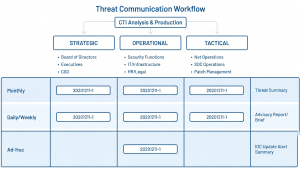
By establishing these clear definitions within our architecture, we eliminate the confusion often found in generalized programs. This structured approach allows us to map specific Priority Intelligence Requirements (PIRs) to the appropriate level of the business, ensuring the right information reaches the right stakeholder at the right time.
Architecture Strategy
The CTI team must establish a structured environment to collect and process raw data from both internal and external sources. This architecture must integrate with the existing tools, systems, and data of other internal teams.
To execute the objectives established in our program management strategy, the CTI Architecture serves as the blueprint for defining the tools and infrastructure required to actualize our intelligence goals. Its purpose is to document and maintain the specific controls, processes, and technologies that align with the core mandate of the CTI function. By implementing workforce automation and establishing robust storage and analysis platforms, the architecture provides the foundation for stakeholders to execute every phase of the intelligence cycle, from initial collection to final dissemination.
To support established CTI service lines, this phase must define:
-
Tactical Cycles: Identifying all cycles and the specific data types required for each.
-
Resource Mapping: Mapping PIRs to specific tools, data types, and sources.
-
Data Support: Ensuring that processing supports both immediate tactical response and long-term strategic analysis.
Automation and Standardization
Ingested data can be technical or non-technical, structured or unstructured. To enable efficient consumption from multiple sources, CTI teams must implement automation and define strict operational requirements. These requirements should focus on:
-
Collection Methods: Determining if feeds require manual extraction or can be automated via API integrations.
-
Source Identification: Pinpointing exactly which external intelligence vendors and internal sensors (like EDR or Firewalls) will be utilized.
-
Data Standardization: Converting varied incoming feeds into established formats readable for both security teams and tools.
-
Technology Dependencies: Defining the platforms needed to access, store, and analyze the feeds.
-
Collection Frequency: Setting schedules for reports, distinguishing between real-time streaming and daily updates.
-
Data Validation: Establishing filter rules to block malformed data and duplicates before they are integrated.
Data and Resource Procurement
Deploying a CTI architecture requires direct financial allocation for commercial feeds, infrastructure licensing, and human capital. Every expenditure must map back to predefined PIRs. Procurement is divided into two operational efforts:
-
External Procurement: Purchasing access to premium threat intelligence vendor platforms, closed-source communities, and commercial APIs.
-
Internal Telemetry Provisioning: Establishing formal access controls and ingestion pipelines for proprietary network telemetry, such as firewall logs and EDR telemetry.
Analyst Hiring and Training
Building a capability requires hiring analysts with technical competencies that align directly with the established infrastructure.
Hiring for a CTI team often involves identifying internal talent from departments that already possess a deep understanding of the organization’s specific technology stack or threat landscape. For example, SOC analysts frequently perform threat intelligence tasks in an unstructured manner without realizing it. Transitioning them into the CTI function is a strategic addition, as they bring a direct understanding of the detection and response team’s operational needs. While these candidates may not yet have a perfect mastery of intelligence methodologies, they can be effectively trained on formal CTI protocols by pairing them with experienced analysts to bridge any knowledge gaps.
Capability building also involves:
-
Platform Training: Training existing personnel on newly deployed vendor platforms.
-
Operational Knowledge: Ensuring analysts have the exact system permissions and knowledge required to process feeds at deployment.
-
Standard Operating Procedures: Establishing SOPs to guide analysts through the newly implemented architecture.
Strategic Partnerships and Service Offerings
Bluewave Cyberdefense provides the infrastructure and expertise required to transition from generic security monitoring to a requirements-driven CTI posture.
Insurance and Sector Intelligence
Through a strategic partnership with PCFG Insurance Services, Bluewave gains a broad, cross-sector perspective on active claims and emerging attack vectors. This partnership enhances our CTI program by:
-
Sector-Wide Visibility: Utilizing anonymized data from insurance claims to identify trends across various industries and geographic regions.
-
Enhanced Risk Assessment: Integrating actuarial-level risk data into our CTI threat profiles to provide clients with a more accurate understanding of their financial and operational exposure.
Identity Threat Detection and Response (ITDR)
Bluewave has launched an ITDR service powered by Vectra. This capability focuses on the most critical component of modern intrusions: Identity.
-
Behavioral Baselining: Monitoring for account anomalies and deviations from established user patterns to identify credential theft in real-time.
-
Identity Monitoring: Continuous surveillance of account permissions and privilege escalations to prevent lateral movement.
Managed CTI Services
The Vectra CTI Platform is currently under development as a dedicated software solution, but is immediately available as a managed service.
-
Company-Specific Intelligence: We perform targeted monitoring for intelligence relevant to your specific domain, infrastructure, and personnel.
-
Proactive Threat Analysis: Providing human-led analysis of external threats to ensure that defensive controls are updated before an adversary targets the organization.
Conclusion
By transitioning from high-level requirements to a concrete operational capability, organizations can move beyond the passive consumption of data and begin driving proactive security outcomes. This maturity is achieved by aligning specialized toolsets, automated architectures, and skilled personnel directly with the business’s most critical intelligence needs. When your architecture and human capital are properly synchronized, the CTI function becomes a vital strategic asset rather than just an information feed.
Next week, we will dive deeper into the next stage of this journey: Tactical Collection and Planning.